
Open Practices for Wicked Problems: Anna Mills on Navigating AI in the Writing Classroom
My Interview with Lisa Sperber for Writing on the Edge

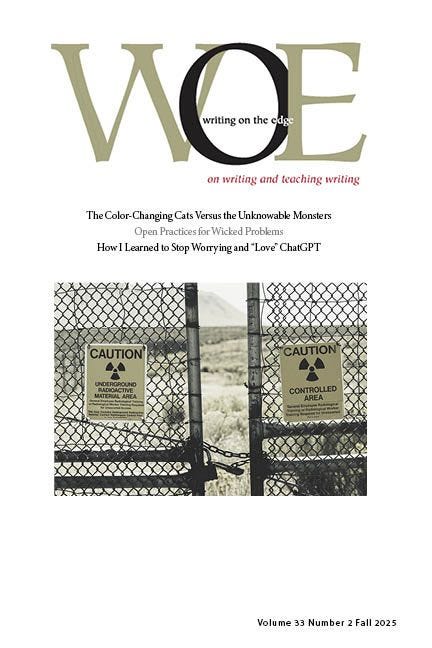
I was honored to be interviewed by Lisa Sperber for Writing on the Edge, a wonderful journal edited by Carl Whithaus. Lis is my friend and one of the main architects of the Peer & AI Review + Reflection project. I’m also grateful to Sophia Minnillo and Joy Ok for editing the piece.
“Open Practices for Wicked Problems” could be seen as a cryptic title. “Open practices” alludes to practices of sharing and collaboration associated with the Open Educational Resources movement, a concept Lance Eaton, Maha Bali, and I explored in How do we respond to generative AI in education? Open educational practices give us a framework for an ongoing process.
“Wicked problems” alludes to “The Wicked Problem of AI and Assessment” where Thomas Corbin, Margaret Bearman, David Boud, and Phillip Dawson describe some insoluble dilemmas and ways educators can move forward.
Here are a few teasers from the interview. We covered so many topics, but you could say I was making a case for an open ethos with each one.
Topic: Speaking out when you come from the lower echelons of academia
Favorite quote: “Lisa: You’re an adjunct at the College of Marin, and speaking from personal experience, our positions as adjuncts and lecturers aren’t always valued by academic institutions. But you’re also one of the leading voices on AI and education. So, I want to ask, how did that happen?” I talked about how growing up in Silicon Valley with an AI engineer father, discovering the Open Educational Resources movement, and losing my job at City College of San Francisco all made me bold.
Topic: How the collaborative ethos of Open Educational resources helps us handle AI.
Favorite quote: “Lisa: I like that we’re talking about teachers collaborating intellectually because weirdly enough, teachers are often not thought of in these intellectual roles. It’s part of the institutional division of labor, at least at the university level– researchers are supposed to be the ones who do the real thinking, and those who can’t, teach, right? But teaching is really intellectual work.“
Topic: Social media as a learning space
Favorite quote: “Me: It was all very foreign at first, and I felt sort of shaky with it, and then gradually I gained confidence. Social media was a space where I was turning to people and learning from them. The sense of responding quickly in the moment just felt so useful. It was also a space to share this sense of bewilderment, awe, confusion, and fear—all the feelings about the emergence of generative AI.”
Topic: The AI refusal movement
Favorite quote: “Me: [I]n order to build AI literacy, in order to understand and speak back, and try to shape AI, and reduce harms, do you need to actually use it? Do you need to have experience understanding what it can do, how you would work with it, what other people are doing with it? Do you need that experience? …I would argue that you do. “ I go on to qualify that claim.
Topic: Shaping the not for profit MyEssayFeedback.AI app to fit writing pedagogy
Favorite quote: “Me: What was amazing to me was that here was a fellow teacher building this tool for a nonprofit organization, and he was listening to what a teacher in the field was saying. So I really couldn’t resist working with somebody who would listen to me and who would build the thing, even though it has been unpaid! “
Topic: Testing feedback prompts with the Peer & AI Review + Reflection Project
Favorite quote: “Lisa: At some point we were testing prompts, and I was thinking, wow, we are not computer science people, but we are educators, and we have a completely different perspective when we read AI feedback. Between us, the PAIRR Curriculum team has over 100 years of combined teaching experience, so when we’re looking at AI outputs, we have all sorts of pedagogical responses. It was an interesting model of prompt development.”
Topic: AI detection
Favorite quote: “Me: [] I think we should recognize that we’re constantly asking suspicious questions in our heads, right? Trying to use the AI detectors in our heads. If we keep in mind the imperfection of software, recognizing that detection is not perfect, and we should be cautious in believing it, then it really would make sense to get some help with that.“
Topic: Agentic AI in learning management systems
Favorite quote: “Me: But now an agent will navigate a digital environment for you, and if you want to give it permission, it will take actions in that environment…[W]e need to be proactive and say, ‘Hold on. You want to be a learning management system? Take this very simple step to protect your space for learning for humans!’”
I hope you’ll read the whole interview here! If you’re not able to access it through an institutional JSTOR account, just email me at annarmills@gmail.com, and I’ll be happy to send you a copy. I’m hoping to write more about Carl Whithaus’s moving and playful introduction to the issue in a later post…
This is a great interview, Anna! And I appreciate that you highlight the parts that you feel best represent your ideas. I love this frame of open practices for wicked problems, and I agree 100%! We are stronger together as we navigate the challenges of genAI in our classrooms. Thank you for being a leader in this space!